
By NewsWaveUSA Team | Published: November 25, 2026 · 2:51 AM ET | Last updated: November 25, 2026 · 2:51 AM ET
Source: BBC News
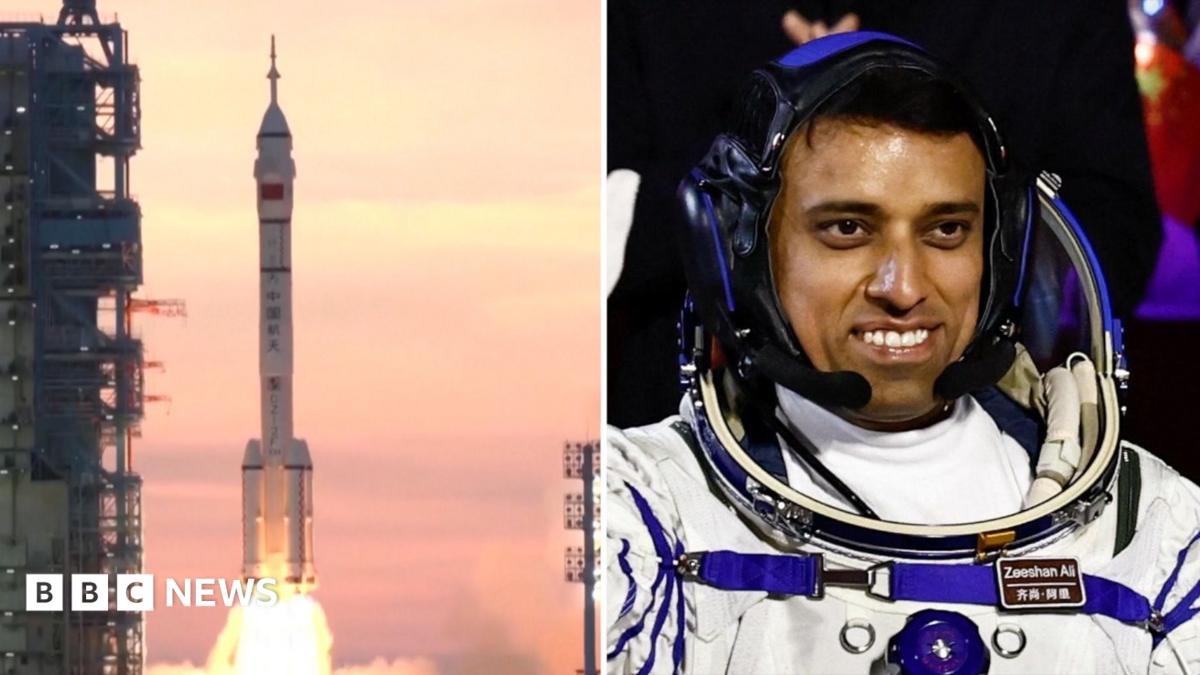
China lifted off its Shenzhou‑24 crew on Wednesday, sending three astronauts aloft toward the Tiangong space station. Among them was Muhammad Zeeshan Ali, the first non‑Chinese to board the orbiting laboratory, marking a historic step for the nation’s space program. The mission is slated to last several days before the crew returns to Earth.
Launch and flight profile
A J‑15 carrier rocket roared from the Jiuquan Satellite Launch Center at dawn, its payload fairing opening to reveal the sleek Shenzhou‑24 capsule. The three‑person crew—Commander Liu Yang, flight engineer Tang Shengjie and Pakistan’s Zeeshan Ali—settled into their seats as the vehicle cleared the atmosphere. Engineers tracked the ascent in real time, confirming a smooth insertion into low‑Earth orbit and a rendezvous trajectory that will bring the capsule within a few meters of Tiangong’s docking port.
A Pakistani first
Zeeshan Ali, a 38‑year‑old pilot from the Pakistan Air Force, became the first foreign national to step inside China’s Tiangong station. He was selected under a bilateral agreement signed between Beijing and Islamabad in 2022, which aimed to deepen scientific collaboration and share the costs of research in microgravity. “It is a great honor for Pakistan and for me personally to join this mission,” Ali said in a pre‑flight interview, adding that the experience will inspire a new generation of engineers back home.
Scientific agenda and daily life aboard Tiangong
The Shenzhou‑24 crew will conduct a series of experiments ranging from materials science to biomedical studies. One focus is the behavior of human immune cells in space, a line of inquiry that could inform treatments for diseases on Earth. Ali is slated to operate a small suite of instruments developed by Pakistani universities, marking the first time Pakistani research will be run in orbit. Outside the lab, the astronauts will perform routine maintenance, exercise on a treadmill, and capture Earth‑rise photos that will be shared with the public.
Geopolitical ripple effects
China’s decision to welcome a foreign astronaut underscores its ambition to position Tiangong as an international hub, rivaling the International Space Station’s long‑standing multinational model. While the United States and Russia have traditionally dominated crewed spaceflight, Beijing’s outreach to nations like Pakistan signals a strategic push to broaden its influence in the emerging space economy. Analysts note that the move could pave the way for additional partnerships, especially with countries that face restrictions on accessing Western launch services.
Looking ahead
Shenzhou‑24 is expected to remain docked for roughly a week, after which the crew will undock and fire the capsule’s retro‑rockets for a controlled re‑entry over the Inner Mongolia desert. Recovery teams will be on standby to secure the spacecraft and retrieve data caches. The mission’s success will feed into China’s broader timetable, which includes plans for a larger modular station and eventually a lunar outpost. For Ali, the flight is a personal milestone and a stepping stone for Pakistan’s budding space ambitions.
The launch has captured the imagination of viewers across both nations, with live streams drawing millions of eyes. Social media buzzed with pride‑filled messages from Pakistani officials and Chinese scientists alike, highlighting a rare moment of cooperation in an era often defined by competition.
Source: BBC News
Spotted an error? Report an error or use our contact form | Corrections policy